Kootenay’s Flagship Exploration Project for Tier One Deposit - Pb-Zn-Ag-Cu
Large Land Package over 25,000 hectares spanning prospective Aldridge Formation stratigraphy, analogous to that hosting the 160Mt Sullivan SEDEX/Replacement deposit.
High priority targets already identified using combination of traditional and innovative exploration methods
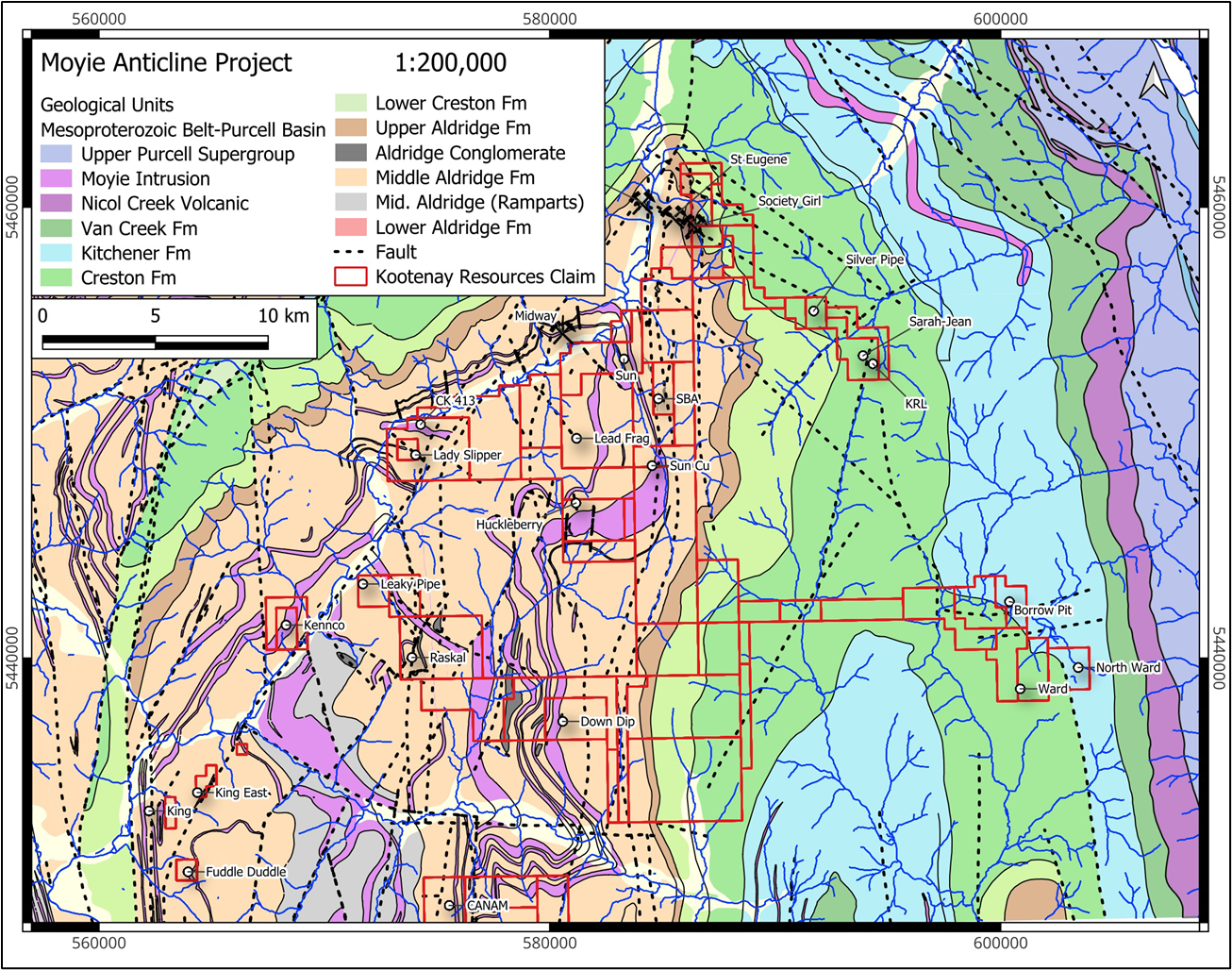
Kootenay Resources’ Flagship Moyie Anticline Project is located 25km east of Creston, B.C. and 20km south of Cranbrook, B.C. The property extends from the township of Moyie southward to the US-Canadian border and comprises a large, early-stage exploration property totaling 26,536 hectares. The Moyie Anticline Project has significant discovery potential based on its geological and structural setting. Kootenay is actively exploring the region for a large scale, “Tier One”, multi-generation mine-life copper, lead, zinc +/- silver deposit.
Project location plan showing mineral showings within the claim boundaries. White circles represent locations and local names of mineral showings on the property
Setting
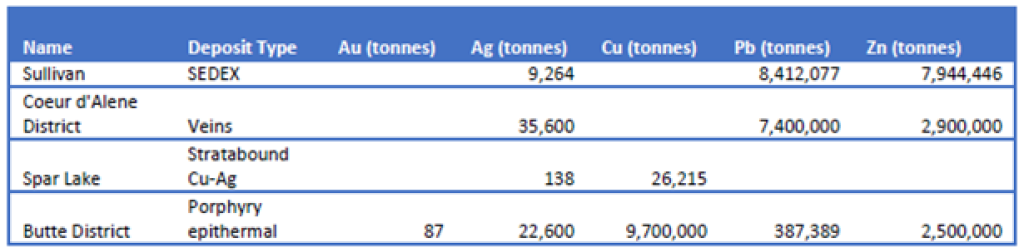
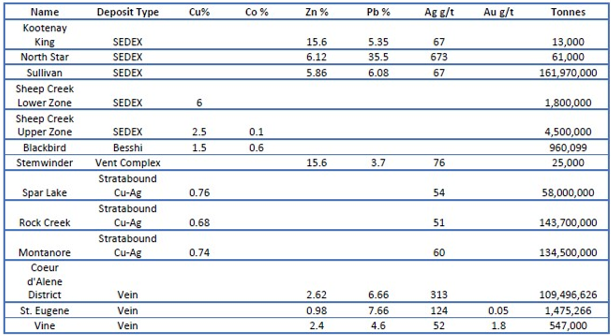
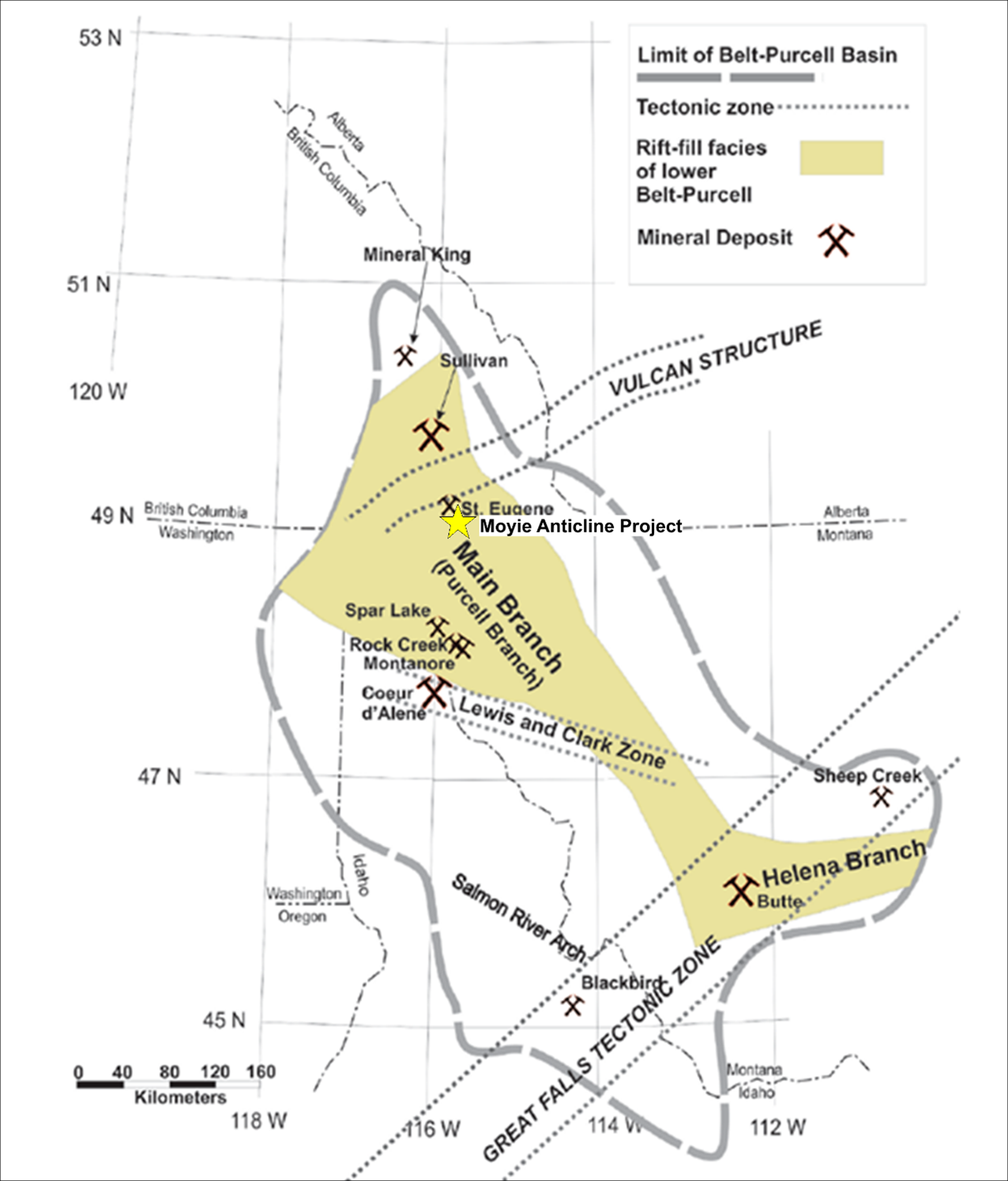
Moyie Anticline Project is underlain by rocks of the Purcell Supergroup, the Canadian equivalent to the USA’s Belt Supergroup, both referring to an extensive, up to 18km thick-sequence of mid-Proterozoic aged clastic and carbonate rocks deposited in an ancient basin on the western margin of ancestral North America. The footprint of the basin exceeds 200,000km2 and extends southward from British Columbia, into Idaho, Montana and Washington states. Collectively known as the Belt-Purcell, the basin is host to several well-known mineral deposits and camps, including the giant Sullivan Pb-Zn-Ag deposit in B.C. which achieved total production of 300 Moz silver, 8.4 Mt lead, 7.9Mt zinc production of copper, gold and other minor metals (source B.C. Minfile No. 082FNE052), the Rock Creek-Montanore and Troy deposits of the Western Montana Copper Belt, the Ag-Au +/-Pb, Cu deposits of Coeur d’Alene Mining District in Idaho and Cu-Ag +/-Mo deposits of Butte Montana.
Kootenay’s Moyie Anticline Project centers on an uplifted portion of the Purcell Basin, a gently north-northwest plunging anticline. Much of the lower stratigraphy of the Belt-Purcell is exposed on the project, including the same strata that hosts the Sullivan mine.
Table listing production from major mining districts within the Belt-Purcell (reproduced from Kennedy and Höy 2016 – after Lydon, 2007)Mesoproterozoic deposits located within the Belt-Purcell (reproduced from Kennedy and Höy 2016 – after Lydon, 2008)Location Map showing extent of Belt Purcell and location of major mineral camps (reproduced from Kennedy and Höy – Geoscience BC Report 2016-19).
Exploration
The Kootenay Resources team is focused on the discovery of a “Tier One” mineral deposit. As such, efforts are focused on the identification of characteristic features of large-scale mineral deposits. In addition to traditional exploration methods including geological mapping, prospecting and geochemical sampling, Kootenay is employing a novel approach using deep sensing geophysics to help with target prioritization. Guided by renowned geophysicists Dr. Fred Cook and consultant Dr. Alan Jones, Kootenay has undertaken to search for crustal scale anomalies using Magnetotellurics (“MT”), a method that detects variations in electrical conductivity with depth and has been used effectively in exploration of other deposits worldwide.
By combining historical and newly-acquired MT data, a series of promising anomalies are identified, some co-incident with low-resistivity “conduits” extending from deep in the crust. Results from the MT work when interpreted in conjunction with existing geological, geochemical and structural data has produced a series of highly anomalous target zones prospective for the discovery of deposit-scale mineralization.
Kootenay also employs a novel approach to existing hand-held XRF technology. Led by Dr Tom Richards and Craig Kennedy, the team is actively developing new methods of testing for pathfinder signatures within the limonite (iron oxide) coatings on fractures of outcropping rocks. The approach involves analyzing multiple samples from a particular site, with a focus on the composition of secondary minerals found on joint surfaces and fracture planes. The method to date has returned encouraging results, discerning clearly anomalous zones from others, despite similar whole rock geochemistry.
This approach is especially effective in the Moyie where the target stratigraphy is largely composed of very fine grained “tight” rocks arranged as sub-horizontal to gently dipping units. These conditions tend to restrict upward fluid migration to distinct structural zones and laterally along contacts, often limiting the development of strong surface geochemical signatures.
The Limonite program has analyzed some 6,000 samples from more than 500 sites at Moyie Anticline and is rapidly becoming a key technique used by Kootenay to evaluate and prioritize targets identified by traditional prospecting and geophysical methods.
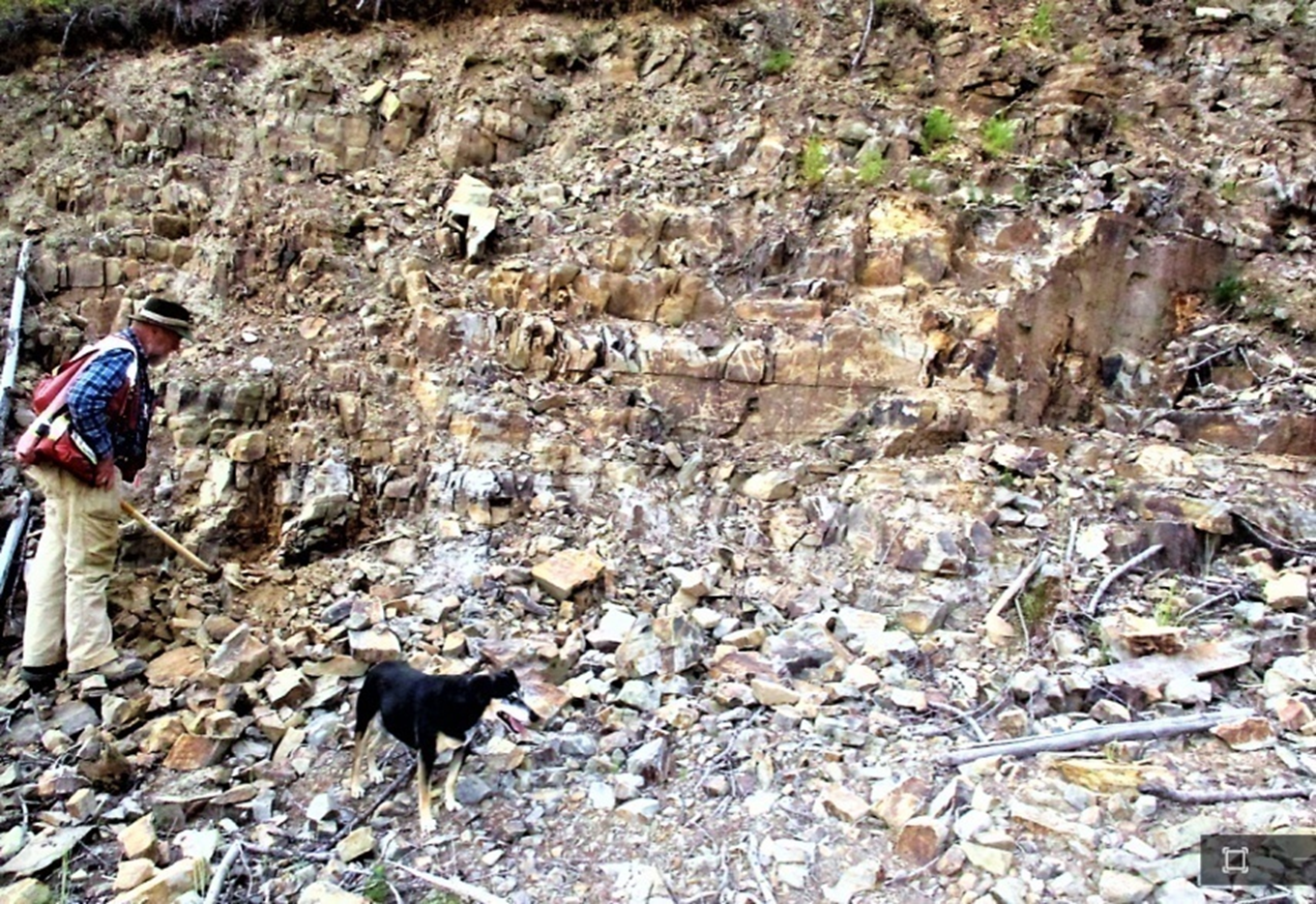
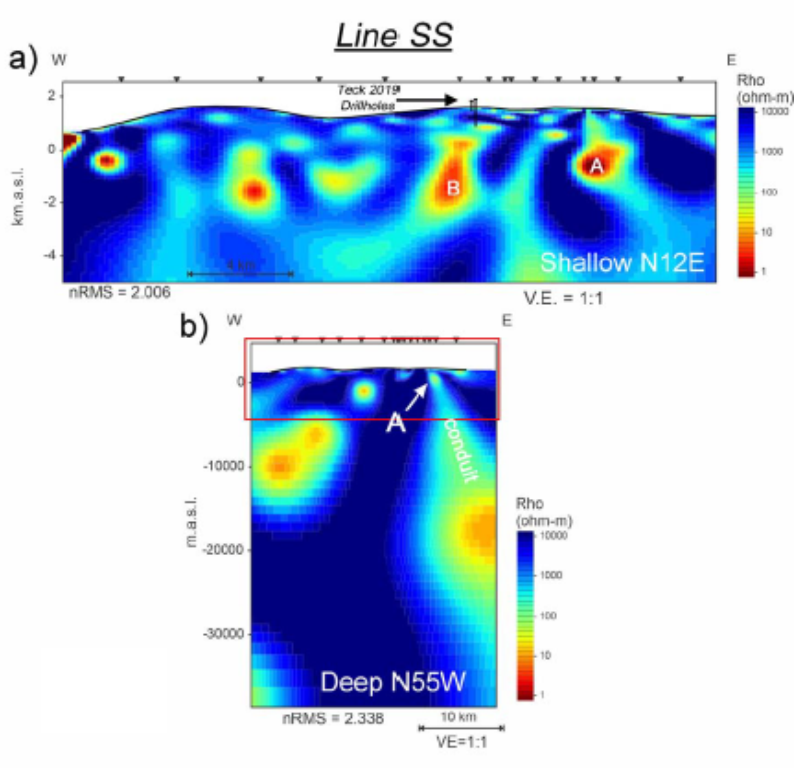
Typical limonite sample collection siteMagnetotelluric section through the Sweet Spot (SS) anomaly (conductor ‘A’) processed for the high frequencies (shallow) above 5 km. b) Same data processed for the deep (low frequency, below 5 km depth) part of the section. Note the apparent conduit-like feature that intersects anomaly ‘A’. The red rectangle in (b) outlines the part of the section that is enlarged and enhanced in (a).
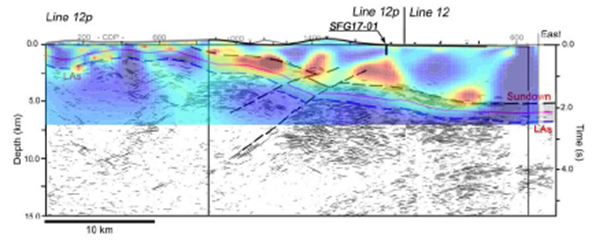
Seismic reflection profile on the east flank of the Moyie anticline with the results from the MT results overlain. The location and depth (588m) of the SFG17-01 drill hole are shown. The drill hole had significant amounts of Cu in the lower part of the hole, but did not quite reach the conductor beneath the hole.
Exploration cont.
Recent fieldwork includes the collection of 48 new MT stations during summer 2023 which were integrated into the main dataset. Kootenay ran 3D inversions on three discrete clusters of MT data over pre-exiting anomalies from previous years’ work. The resulting models reveal encouraging anomalies associated with deep low-resistivity conduits, though in some cases the anomalies extend beyond the limits of the surveys.
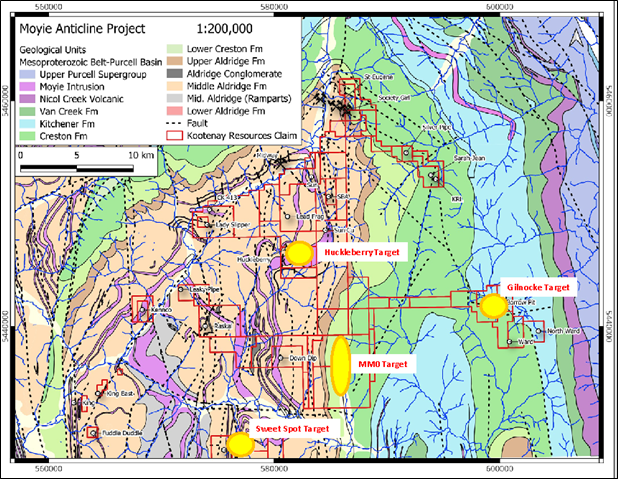
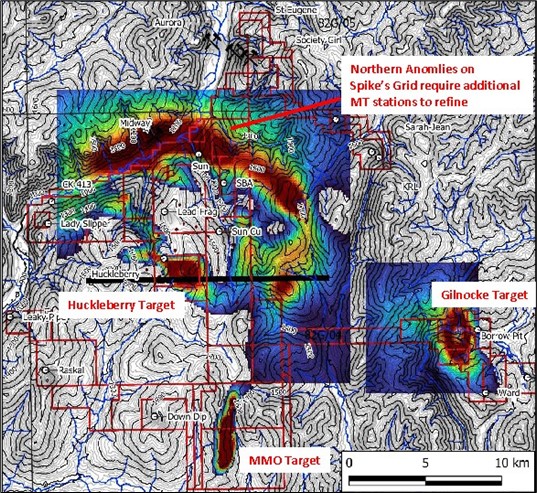
Prospective targets on the property include the MM0, Sweet Spot, Huckleberry and Gilnocke areas, with additional targets also ready for additional testwork.
Exploration plans for 2024 include the completion of additional MT stations to better resolve the larger anomalies detected in 2023, a property-wide 3D inversion of all available data and prioritization of drilling targets. Kootenay is continuing with ongoing consultation and permitting process.
Location plan showing the Moyie project and follow up targets for 2024
Plot showing 3D inversion anomalies following integration of new 2023 MT data.
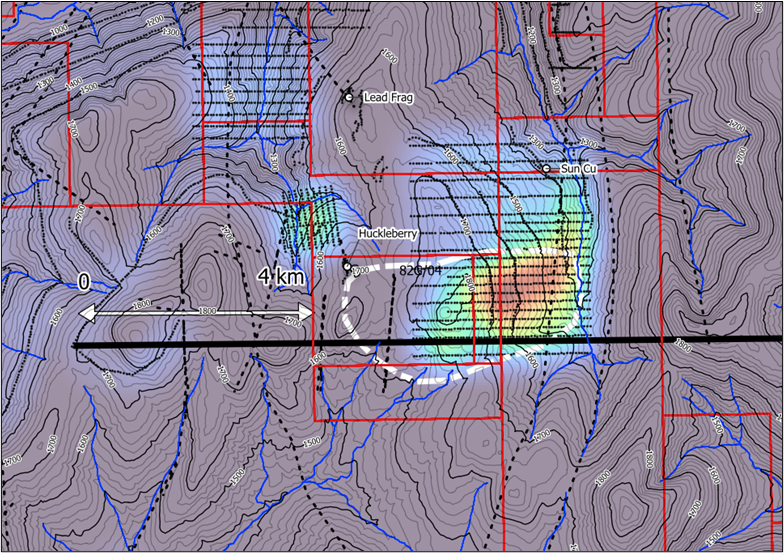
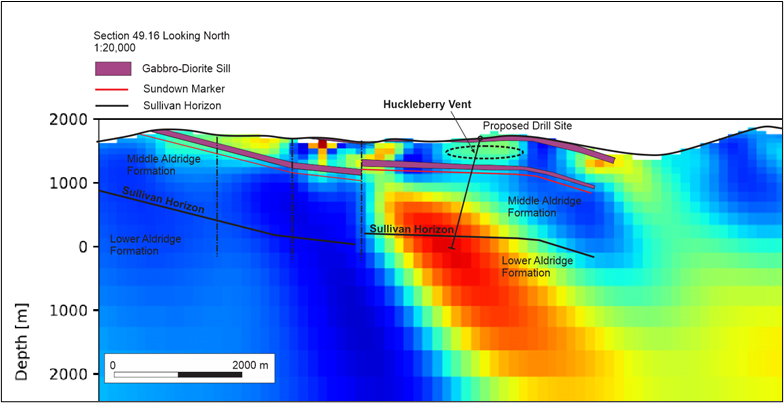
Huckleberry Target
Huckleberry target area, MT anomaly (dashed grey line) co-incident with existing copper-in-soil anomaly (coloured heat map shows a strong 1km x 1.5km zone of elevated Cu values relative to surrounding samples) .Huckleberry target area, MT anomaly (dashed grey line) co-incident with existing copper-in-soil anomaly (coloured heat map shows a strong 1km x 1.5km zone of elevated Cu values relative to surrounding samples) .
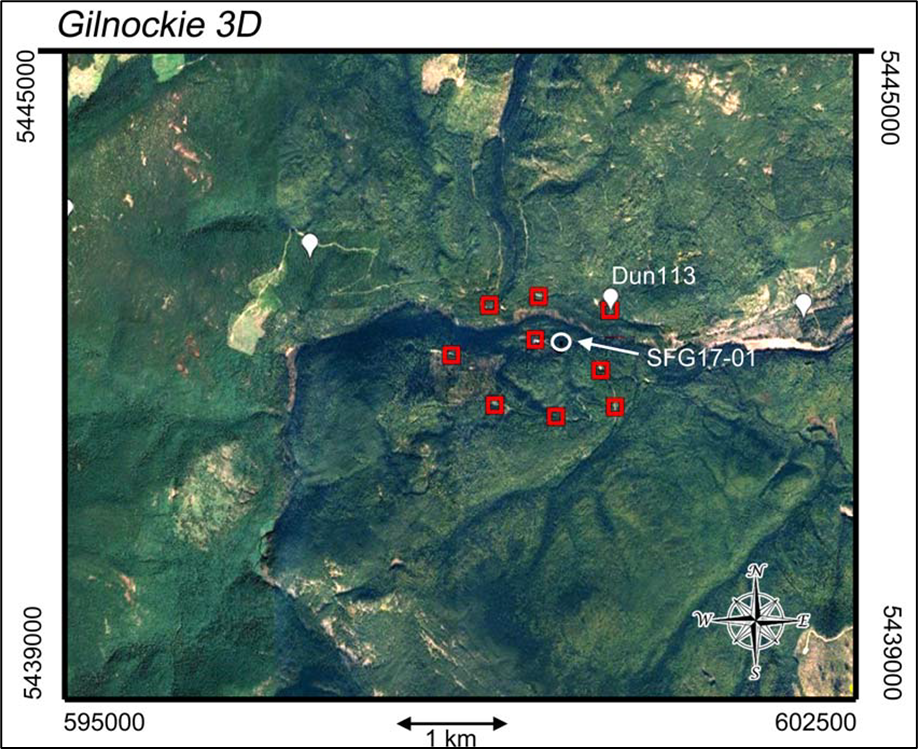
Glinocke target
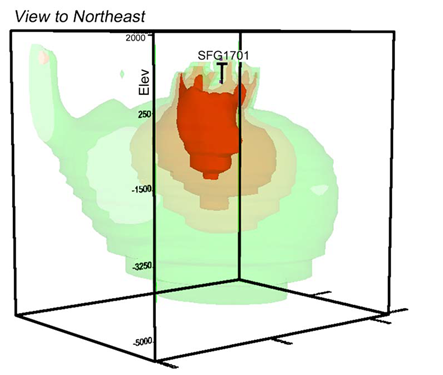
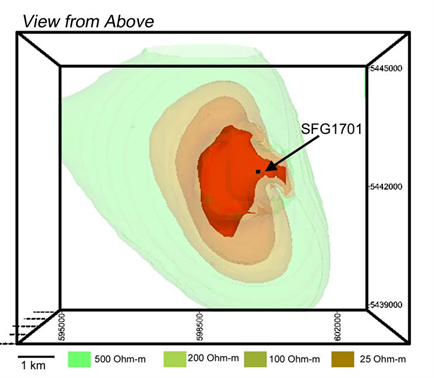
Gilnocke MT station array; white stations are historical Duncan Energy MT stations, red stations are Kootenay Resources 2023 stations. SFG17-01 is drillhole completed in 2017 during a regional evaluation by Antofagasta3D depictions of MT low-resistivity anomaly at Gilnocke target. Historical drillhole is located above the new anomaly, SFG17-01 encountered alteration and weak Cu and Pb mineralization, did not continue to a depth to sufficiently test the low-resistivity anomaly.3D depictions of MT low-resistivity anomaly at Gilnocke target. Historical drillhole is located above the new anomaly, SFG17-01 encountered alteration and weak Cu and Pb mineralization, did not continue to a depth to sufficiently test the low-resistivity anomaly.
MM0 Target
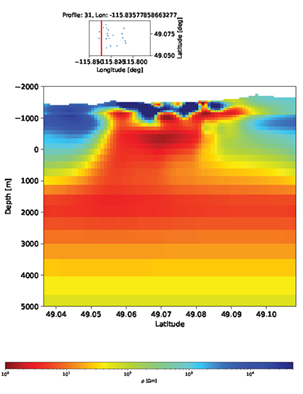
Section on left showing MM0 Anomaly looking west. Very strong low-resistivity signature masks detail deeper than 1000m below mean seal level. Image on right shows horizontal slice of MM0 anomaly at 490m above mean sea level. Location of MT stations shown as black dots on image and inset reference paneSection on left showing MM0 Anomaly looking west. Very strong low-resistivity signature masks detail deeper than 1000m below mean seal level. Image on right shows horizontal slice of MM0 anomaly at 490m above mean sea level. Location of MT stations shown as black dots on image and inset reference pane
Sweet Spot Target
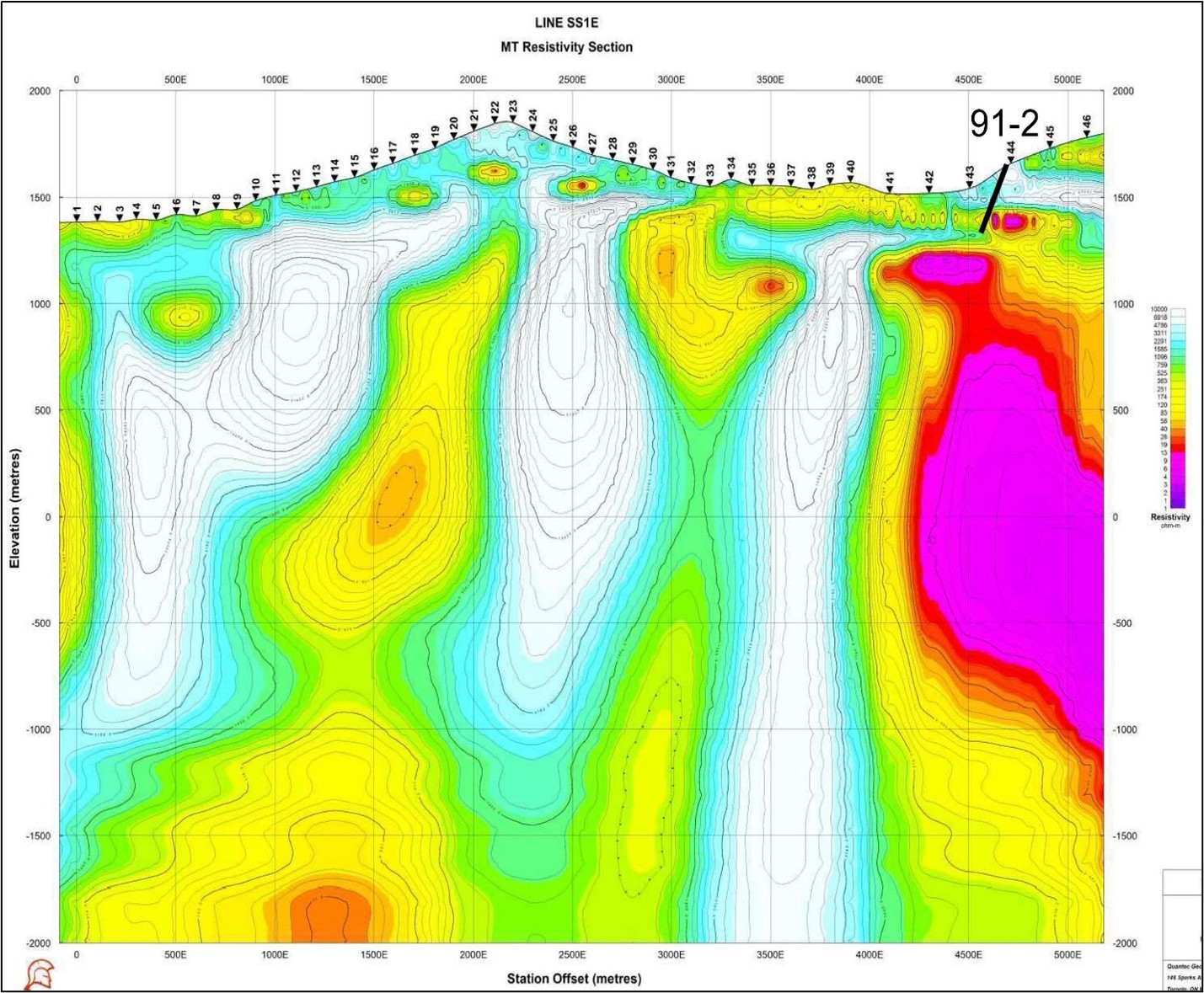
2D inversion of MT data from Sweet Spot anomaly taken from BC Assessment report #37386. Trace of historical drillhole 91-2 projected.